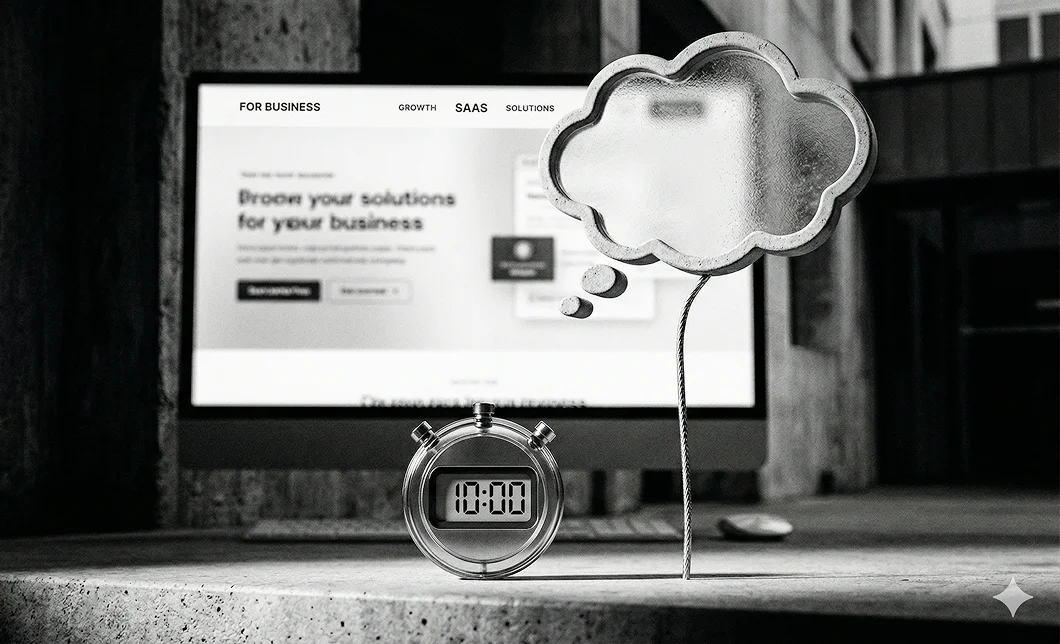
It is not a design problem. When qualified B2B prospects visit your site and do not book a call, the homepage is answering the wrong question. It is telling them what you do. They came to find out if you understand what they are dealing with.
What is website positioning?
Website positioning is the alignment between what a visitor expects to find, based on the search query or referral that brought them, and what the first screen of your website actually communicates. A well-positioned website answers three questions in the first 10 seconds:
- Who is this for?
- What specific problem does it solve?
- Why this company rather than another?
A redesign improves how those answers are presented. Only positioning work can determine what those answers actually are.
The 10-second test
The average time a B2B decision-maker spends on a company homepage before deciding whether to scroll or leave is under 10 seconds. In that window they are not reading your methodology, your team page, or your case studies. They are answering one question: is this relevant to my situation right now?
We worked with a company running significant paid search spend. The ads were performing. The website was not converting at the rate the spend warranted. When asked what the homepage was communicating in the first screen, the founder described their heritage, expertise, and values. None of those things are what a qualified buyer searching for a specific solution needs to see at the moment of intent. They are looking for a direct answer to the problem that brought them there. That is not a tagline. That is a positioning statement that answers the search intent in the first sentence.
The 10-second test: ask someone who has never seen your website to look at the homepage for exactly 10 seconds, then close it. Ask them: who is this for? What problem do they solve? If the answer to either question is "I'm not completely sure," your positioning is broken. And no amount of design work will fix it until you answer those two questions first.
Three signs your website is failing at positioning, not design
High traffic, low time on page
If visitors arrive and leave within 10 to 15 seconds consistently, the message is not matching the intent. The design is not the problem. A redesign will not change the bounce rate if the first sentence still describes your company rather than the visitor's situation.
Good inbound, poor conversion
Visitors click on the ads, arrive on the page, and do not book a call or fill a form. This is the clearest positioning failure: the ad created a promise and the website did not deliver on it. The visitor came looking for recognition of their problem and found a description of your capabilities.
Long sales cycles starting from the website
When prospects who found you through the website take significantly longer to close than referred prospects, the website is creating doubt rather than certainty. Referrals come pre-qualified. Website visitors need the website to do the qualification work. If your positioning does not pre-qualify and pre-disqualify, your sales team has to do it manually on every call, at a cost that compounds across every deal in your pipeline.
Why redesigning before repositioning is expensive
The most common mistake: a company commissions a full website redesign, new design system, new photography, new copy, without having done the positioning work first. Six months and €60k later, the website looks better and converts at the same rate.
This happens because design agencies are not positioning agencies. They can make your positioning statement look credible. They cannot create it. A company that has not answered "who specifically is this for, and what specific pain are we solving?" will produce a beautiful website that communicates the wrong thing beautifully.
The fragmented external provider model makes this worse. We worked with a B2C company in a sector with strict advertising restrictions. They had a paid media freelancer, a CRM agency, an SEO agency, and an internal content team, all running in parallel with no strategic lead to unify them. Paid media drove traffic based on one promise. The website received that traffic with a different message. The positioning gap was invisible in any individual agency report. It showed up in aggregate conversion rate and cost per closed deal. For more on the structural risk of fragmented providers, see The CMO rescue plan.
The positioning work that needs to happen before any design brief is written: one sentence that names the specific buyer and the specific pain, three proof points that translate capabilities into business outcomes, and one clear next step per page. That work takes two to three focused sessions. It does not require a brand agency.
The 30-day positioning fix
No new design budget required. Four weeks, four actions.
A part-time CMO typically closes this gap in under 30 days, without touching the design or the budget.
Week 1: run the diagnostic
Pull your last 20 leads that came through the website. For those who converted, what did they say they were looking for when they booked the call? For those who did not convert, what did they see that did not match their need? If you can reach five of them, ask directly. This data defines what the positioning needs to say, in the language your buyers already use.
Week 2: rewrite the homepage headline
One sentence naming who this is for and what pain it solves. One sentence on what the outcome looks like. Test both with three to five people from your ICP before publishing. If they cannot feed back your own headline in their own words, it is not clear enough.
Week 3: add three proof points
Not features. Not "we have 10 years of experience." Outcomes: "Client X reduced their CAC by 30% in four months." "Client Y went from a six-month sales cycle to eight weeks." Real numbers, real timelines. If you do not have those numbers yet, getting them is a higher priority than any design update.
Week 4: audit every CTA
Is there one clear primary action per page? Does the CTA copy describe the outcome of taking the action, "Book a 30-minute revenue diagnostic," rather than the action itself, "Contact us"? Is the friction to take that action minimal? Four weeks, no new design budget. The conversion improvement is visible within the first full month of traffic following the changes.
As a CEO, how do I know if my website's problem is positioning or something technical like page speed?
Look at the sequence of events. If your time on page is under 15 seconds across all traffic sources, including direct and referral, not just paid, the problem is positioning. Visitors who found you through a warm recommendation and still leave in 10 seconds are telling you the page did not confirm what they expected to find. Page speed affects whether the page loads. Positioning affects whether the visitor stays once it does. Both matter, but positioning failures are ten times more common than technical failures at the conversion stage for B2B companies.
How much does poor website positioning cost a B2B company in lost revenue over a year?
The calculation is straightforward: take your monthly unique visitors, multiply by the gap between your current conversion rate and the benchmark for your category (typically 2 to 4% for B2B SaaS in 2026, 1 to 2% for professional services), then multiply by your average deal value. For a company with 5,000 monthly visitors, a 0.5% conversion gap, and a €15k average deal size, that is 25 additional closed deals per year, or €375k of annual revenue sitting unrealised on your homepage. The 30-day positioning fix costs less than a single lost deal.
If your website is receiving qualified traffic and not converting it, the positioning layer is broken. We diagnose the gap and rebuild the conversion architecture. Talk to iytro.